Can You Bring a CPAP, APAP, or BiPAP
Machine on a Cruise? Everything You Need to Know
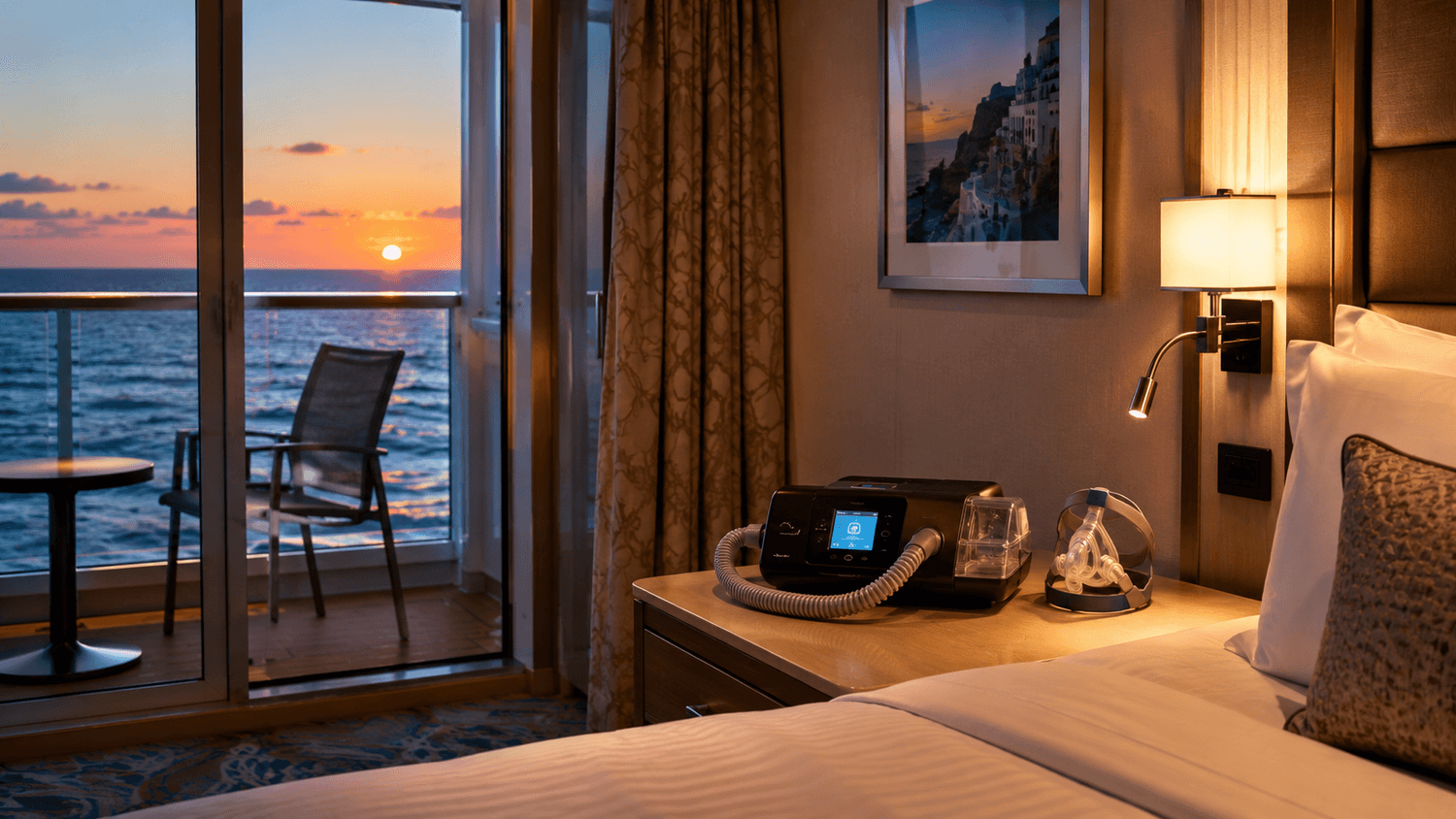
Being diagnosed with sleep apnea probably isn't something most people expect to add to their cruise-planning checklist.
It certainly wasn't on mine.
I was recently diagnosed with obstructive sleep apnea and prescribed an APAP machine. Since I already had a cruise coming up, I suddenly found myself thinking about travel questions I'd never needed to consider before.
Can I take an APAP on a cruise? Do I have to tell the cruise line? Will they provide distilled water? Where am I going to plug it in? Can I use an extension cord? And what happens when I have to fly with the machine?
If you've recently been diagnosed like me—or you've used a CPAP, APAP, or BiPAP for years—the good news is that traveling with one doesn't have to make cruising complicated.
People travel with PAP machines all the time, and major cruise lines are accustomed to accommodating passengers who use them. But there are a few things you'll want to arrange before you leave home.
Yes, You Can Bring a CPAP, APAP, or BiPAP on a Cruise
Let's get the biggest question out of the way first.
Yes, you can cruise with a CPAP, APAP, or BiPAP machine.
Cruise lines routinely carry passengers who use positive airway pressure therapy.
Carnival, for example, specifically permits CPAP, APAP and BiPAP machines onboard and does not require guests to obtain advance permission simply to bring one. Royal Caribbean also specifically accommodates passengers traveling with PAP equipment.
Although the three machines work somewhat differently, the practical travel issues are essentially the same.
You need to think about transporting the machine safely, having electrical power near your bed, obtaining distilled water if you use a humidifier, and making sure you have enough supplies for the entire trip.
And some of those things need to be handled before your cruise begins.
Request What You Need Before Your Cruise
This is probably the most important thing I learned while preparing for my first cruise with an APAP.
Most major cruise lines are familiar with passengers traveling with CPAP, APAP and BiPAP machines and will make reasonable efforts to accommodate what you need.
But each cruise line has its own procedures and its own pre-cruise timeline for requesting medical assistance, equipment or supplies.
There isn't one universal deadline that applies to every cruise line.
If you need something such as distilled water, an extension cord or another accommodation, go to your cruise line's accessibility or special-needs information and find out what they require.
Then make the request in writing within that cruise line's requested timeframe.
I'd also save the confirmation so you have a record of exactly what you requested.
Royal Caribbean, for example, currently asks guests to provide 30 days' advance notice for distilled water and extension cords. Carnival has different procedures and does not require advance notification simply because you're bringing a PAP machine.
I Didn't Give My Cruise Line Much Notice
My own timing wasn't ideal.
My cruise was only about 12 days away when I submitted my request for distilled water and an extension cord for my cabin.
Fortunately, the cruise line was able to accommodate both requests despite the short notice.
I was lucky.
I would not use my 12-day experience as a guideline for when you should make your request.
Many people travel with PAP machines, so requests for distilled water and access to power aren't unusual. But that doesn't mean a cruise line will always be able to fulfill a last-minute request.
Check your particular cruise line's requirements and make your request as early as possible.
Next time, that's exactly what I'll do.
CPAP vs. APAP vs. BiPAP: Does It Make a Difference When You Cruise?
For travel planning, not very much.
A CPAP provides continuous positive airway pressure at a prescribed setting.
An APAP, or auto-adjusting positive airway pressure machine, adjusts pressure within a prescribed range while you're sleeping.
A BiPAP provides different pressure levels for inhalation and exhalation.
Your healthcare provider determines which type of therapy is appropriate for you.
For cruising, however, all three machines create essentially the same logistical questions:
How do I transport it? Where do I plug it in? Do I need distilled water? And what supplies should I bring?
That's why I'll sometimes use the broader term PAP machine throughout this guide.
Will the Cruise Line Provide Distilled Water?
Often—but don't assume it.
This is one of the first things I thought about because I plan to use humidification with my APAP.
Cruise lines handle distilled water differently.
Royal Caribbean currently lists distilled water among the accommodations it provides with advance notice. Carnival sells distilled water specifically for CPAP machines and allows passengers to hand-carry their own distilled water with their PAP equipment.
So the answer isn't simply:
"Yes, cruise lines give you distilled water."
Your cruise line may provide it.
It may sell it.
It may allow you to bring your own.
Policies can also change.
Check before you sail.
If the cruise line can have distilled water waiting for you or make it easily available onboard, I'd rather arrange that than haul a heavy jug through embarkation.
A gallon of water weighs more than eight pounds. A gallon of water weighs more than eight pounds, so if the cruise line can provide distilled water onboard, that’s one less heavy item you’ll need to carry with you.
Why I'm Planning to Use Humidification
Not everyone who uses PAP therapy uses a humidifier, and whether you need one is something to discuss with your healthcare provider or PAP equipment provider.
For me, however, this was something I thought about immediately.
I'm already prone to a very dry nose and mouth.
The idea of having pressurized dry air blowing through my airway all night didn't sound particularly comfortable, so I'm planning to start with humidification.
That means distilled water has now joined the list of things I need to think about when traveling.
If you use your PAP machine's humidifier at home, don't wait until you're onboard to figure out how you'll get the water you need.
Add it to your pre-cruise planning.
Can You Bring Your Own Distilled Water?
That depends on your cruise line.
Carnival currently allows passengers to hand-carry distilled water along with their CPAP equipment. It also sells distilled water before and during the cruise.
Other cruise lines may handle it differently.
If you're thinking about carrying your own water onboard, verify the current policy first.
Personally, if the cruise line can supply it, that's the option I'd choose.
What About an Extension Cord?
This is another reason to contact your cruise line before sailing.
Cruise cabins don't always have an electrical outlet conveniently located beside the bed.
On some newer ships, you may have exactly what you need within easy reach.
On an older ship, the main electrical outlet could be across the cabin at the desk or vanity.
Carnival, for example, says its stateroom electrical outlet is located in the desk/vanity area and recommends an extension cord when necessary to operate medical equipment comfortably.
Royal Caribbean lists an extension cord among the items it can provide with advance notice.
That's why I requested one along with my distilled water.
I'd rather have an extension cord available and discover I don't need it than walk into my cabin and discover my APAP cord doesn't reach the bed.
Don't Bring Just Any Extension Cord or Power Strip
This part matters.
Cruise ships have specific rules about electrical equipment.
Something that's perfectly acceptable in your bedroom at home may not be permitted onboard.
Carnival currently permits extension cords but prohibits surge protectors, and it warns that medical electrical equipment may be inspected for safety.
Other cruise lines have their own policies.
If your cruise line will provide an extension cord for your PAP machine, that's an easy solution.
If you're bringing your own, check your cruise line's current prohibited-items and medical-equipment rules before packing it.
Don't assume a power strip or surge protector is acceptable just because you use it at home.
Keep Your PAP Machine With You
I wouldn't put a CPAP, APAP or BiPAP in checked cruise luggage.
Carnival specifically instructs guests to hand-carry PAP equipment rather than place it in checked luggage.
Even without that rule, it makes sense.
Think about embarkation day.
You hand your suitcase to a porter at the terminal, and it may not arrive at your cabin for several hours.
Luggage can occasionally be delayed or misdirected.
That's annoying if the missing item is a pair of shoes.
It's an entirely different problem when the missing item is prescribed medical equipment you need that night.
Your PAP machine belongs with the things you keep in your possession during embarkation:
Medications
Passport and identification
Wallet
Phone
Important travel documents
Valuables
Medical equipment
Your PAP machine stays with you.
What Should You Pack With Your PAP Machine?
I want everything necessary to operate my APAP together rather than scattered through different pieces of luggage.
I'd pack:
CPAP, APAP or BiPAP machine
PAP travel case
Mask
Tubing
Power supply
Humidifier chamber if you use one
Necessary filters
Spare mask cushion or nasal pillows if available
Small replacement mask parts you already own
Cruise-approved extension cord if applicable
Cruise-line confirmation for requested accommodations
PAP equipment provider's contact information
Machine manufacturer and model information
Appropriate international plug adapter if necessary
Make sure the humidifier chamber is empty before transporting the machine.
Water and electronics don't make particularly good travel companions.
Consider Bringing a Few Spare Parts
Cruise ships carry a remarkable assortment of things.
I wouldn't count on the onboard shops carrying the exact replacement cushion, filter or mask clip for your PAP machine.
Carnival specifically tells PAP users to bring all necessary supplies because replacement supplies aren't available onboard.
You don't need to bring half the medical-supply store.
But if you already have lightweight spare components, consider packing them.
A tiny broken mask clip isn't much of a problem at home.
In the middle of a seven-night cruise, it could become a very big problem.
Label Your Equipment
Another simple precaution is labeling your PAP travel case.
Carnival recommends labeling medical equipment with your full name, contact information and cabin number.
At minimum, I'd include:
Name
Mobile number
Email address
Once you know your cabin number, you can include that as well.
Travel Tip: I found these inexpensive Medical Equipment luggage tags that can be attached to a CPAP, APAP, or BiPAP carrying case. They make it immediately clear that the bag contains medical equipment and should be handled with care.
Set Everything Up Before Bedtime
Once I get into my cabin, I'm not waiting until I'm exhausted at 11:30 at night to figure out where the APAP is going.
I'd recommend setting things up shortly after you have access to your stateroom.
Check:
Where is the electrical outlet?
Does the power cord reach the bedside table?
Is the extension cord you requested there?
Did your distilled water arrive?
Is there a stable place for the machine?
If something you requested is missing, contact your cabin attendant or Guest Services early.
That's much easier than trying to solve the problem when you're already ready for bed.
Watch for Keycard-Controlled Cabin Electricity
Here's something many cruisers may not think about.
Some cruise cabins use a keycard slot to activate electricity in the room.
Remove the keycard and some electrical circuits may shut off.
Carnival specifically warns that some staterooms use this type of energy-saving system and tells passengers who need continuous power for medical equipment to speak with Guest Services.
If your PAP machine requires uninterrupted power while you're sleeping, check the cabin's electrical setup when you board.
What If the Ship Loses Power?
Cruise ships have extensive electrical and backup systems, but temporary interruptions are possible.
Carnival advises passengers who depend on powered medical equipment to consider a fully charged battery or another backup option that doesn't require shipboard electricity.
Whether you need backup power for your particular PAP machine is something to discuss with your equipment provider or healthcare professional.
If you're flying, remember that airlines have rules regarding lithium batteries, so verify those requirements before purchasing or packing a backup battery.
Flying to Your Cruise With a PAP Machine
If you're flying to the embarkation port, you'll need to think about the airport as well as the cruise ship.
PAP machines are common medical devices, but I would still keep the machine together in its travel case and allow a little extra time the first time I fly with it.
Your airline may have its own procedures regarding medical equipment, especially if you intend to use the machine during the flight.
Carnival also advises passengers traveling by air with medical equipment to check directly with their airline for applicable restrictions.
And just as with embarkation:
I wouldn't voluntarily check the machine with my luggage.
Don't Forget About Your Pre-Cruise Hotel
This is an easy one to miss.
Maybe you've arranged distilled water and an extension cord with your cruise line.
Great.
But what if you're spending a night in a hotel before the cruise?
You'll need to use your PAP machine there too.
If you use humidification, figure out how you'll obtain distilled water for the hotel stay.
If you're traveling internationally, check the local electrical system and your machine's power requirements.
Which brings us to another important issue.
Using Your PAP Machine Internationally
Many modern PAP power supplies accept a range of voltages, which can make international travel relatively simple.
But don't assume yours does.
Check the label on your power supply or the manufacturer's specifications for your exact machine.
If the power supply supports the voltage used at your destination, you may only need the correct plug adapter.
And remember:
A plug adapter changes the shape of the plug. It does not convert voltage.
Those are two different things.
Travel Tip: If your PAP machine's power supply is compatible with the voltage at your destination, a universal travel adapter can be useful for international pre- and post-cruise hotel stays. Always check the voltage requirements for your specific PAP machine before plugging it in.
Before using your PAP machine in a hotel in Rome, Barcelona, Athens, London or another international destination, verify exactly what your equipment requires.
Using the Humidifier in Your Cruise Cabin
If you normally use your PAP humidifier, cruising doesn't automatically mean you have to stop using it.
The practical issues are simply having the correct water, preventing spills and keeping the chamber clean.
I'd fill the humidifier after the machine is already positioned where I'm going to use it.
Don't fill the chamber and then carry the machine around the cabin.
And never transport the machine with water still inside the humidifier.
Follow the manufacturer's instructions for filling, emptying, cleaning and drying your particular chamber.
Cleaning Your PAP Equipment During the Cruise
You don't need to turn your cruise cabin into a sterile laboratory.
You do need to continue the normal cleaning routine recommended by the manufacturer of your equipment.
Depending on your machine and mask, that may include cleaning or rinsing:
Mask cushion
Humidifier chamber
Tubing
Other washable components
Let everything dry thoroughly before putting it back together.
I wouldn't experiment with unfamiliar cleaning chemicals, ozone devices or other sanitizing gadgets while traveling.
Stick with the cleaning instructions provided for your actual equipment.
What If Your PAP Machine Stops Working?
Hopefully it won't.
But I'd have a basic plan.
Know the:
Manufacturer
Machine model
Mask model
Equipment supplier
Supplier's contact information
If the problem appears to be with the cabin electricity, contact Guest Services.
If the machine itself malfunctions, don't assume the ship will be able to repair it.
Cruise-ship medical centers treat illnesses and injuries. They're not PAP repair shops.
If you have medical concerns about being unable to use prescribed therapy, contact the ship's medical center for guidance.
Do You Need a Travel CPAP for a Cruise?
Not necessarily.
A smaller travel machine can be convenient, but you don't automatically need to purchase a second PAP machine because you're taking a cruise.
If your regular machine travels reasonably well and you're comfortable using it, you may prefer to bring the equipment you're already accustomed to.
If you're considering a separate travel machine, discuss your options with your PAP provider or healthcare professional.
Don't Stop Using Your PAP Just Because You're on Vacation
Cruises disrupt normal routines.
You stay up later.
You may have a few drinks.
You may come back exhausted after a long shore excursion.
But prescribed PAP therapy doesn't stop being prescribed because you're on vacation.
Follow the treatment instructions you've been given.
If you're struggling with the machine or considering changing your prescribed settings or therapy, contact your healthcare provider or PAP equipment provider rather than making significant changes on your own.
PAP Cruise Packing Checklist
Before leaving home, I'd run through this quick checklist.
PAP Equipment
CPAP, APAP or BiPAP
Travel case
Mask
Tubing
Power supply
Humidifier chamber
Filters
Spare mask parts if available
Cruise Arrangements
Check your cruise line's special-needs requirements
Submit requests within that cruise line's required timeframe
Request or arrange distilled water if needed
Request or verify an approved extension cord if needed
Save written confirmation of your requests
Check the cruise line's electrical-device rules
Travel Arrangements
Keep PAP equipment with you
Check airline medical-equipment policies
Verify international voltage compatibility if applicable
Pack the correct plug adapter
Plan for your pre-cruise hotel
Travel Tip: I also like the idea of attaching an AirTag holder to your PAP carrying case. While I plan to keep my APAP with me while traveling, a tracker adds another layer of protection if the bag is ever misplaced.
Useful Information
Equipment supplier's contact information
Machine manufacturer and model
Mask model
Healthcare provider information
Copies of relevant cruise-line confirmations
Once you've done it a couple of times, I suspect most of this becomes routine.
Right now, because I'm new to APAP therapy, it's all new to me too.
Frequently Asked Questions
Can I bring a CPAP on a cruise?
Yes. Major cruise lines routinely accommodate passengers who use CPAP and other PAP equipment. Individual policies for supplies and accommodations vary by cruise line.
Can I bring an APAP on a cruise?
Yes. Carnival, for example, specifically lists APAP among the breathing devices permitted onboard.
Can I bring a BiPAP on a cruise?
Yes. BiPAP machines are also routinely permitted aboard cruise ships.
Do I have to notify the cruise line?
Not necessarily just because you're bringing the machine. Carnival currently says PAP devices don't require advance notification. However, if you need accommodations or supplies, check your cruise line's individual procedures and advance-notice requirements.
How far in advance should I request distilled water or an extension cord?
There is no single timeframe for every cruise line. Each line establishes its own requirements. Royal Caribbean currently asks for 30 days' notice for distilled water and extension cords.
I made my own request only about 12 days before sailing, and fortunately my cruise line was able to accommodate me. I wouldn't count on that happening everywhere.
Will the cruise line provide distilled water?
It depends. Royal Caribbean lists distilled water among its available accommodations with advance notice. Carnival sells distilled water for PAP machines and permits guests to hand-carry their own.
Can I bring an extension cord?
Policies vary. Royal Caribbean can provide one with advance notice, while Carnival permits extension cords and recommends bringing one when necessary for medical equipment.
Should I put my PAP machine in checked luggage?
I wouldn't. Carnival specifically tells passengers to hand-carry PAP equipment rather than put it in checked luggage.
What I'm Doing for My First Cruise With an APAP
This is the part of this article that's personal for me.
I'm not writing this as someone who has cruised with an APAP for the past ten years.
I'm newly diagnosed, I'm getting my APAP, and I'm figuring out how to incorporate it into something I've been doing for years—cruising.
I've already requested the distilled water and extension cord I'll need in my cabin.
I made the request only about 12 days before sailing, and fortunately the cruise line was able to accommodate me.
I've learned from that experience already.
Next time, I'll check the cruise line's accessibility requirements much earlier and submit whatever I need within its recommended timeframe.
I'm also learning how to use the machine itself before adding travel to the equation.
If you're newly diagnosed too, I'd recommend doing the same thing.
Learn how the humidifier works.
Learn how your mask fits.
Learn how the tubing connects.
Know how to clean everything.
Know what supplies you need.
Get comfortable with the machine before you find yourself sitting on the edge of a cruise-ship bed trying to figure it out at midnight.
I'll Update This After My Cruise
This article is a little different from many of my Cruising Style guides because I'm actually living this one as I write it.
I'm newly diagnosed.
I'm getting my APAP.
I've made the cruise-line arrangements.
And soon I'll find out what traveling with it is really like.
After the cruise, I'll come back and update this guide with what actually happened.
Was the distilled water there?
Did I get the extension cord?
Where was the cabin outlet?
Was setting up the APAP easy?
How was traveling with it?
And most importantly:
What would I do differently next time?
Those are the things I'd want someone to tell me right now, so those are the things I'll share once I've actually done it.
Final Thoughts
Being diagnosed with sleep apnea doesn't mean cruising suddenly becomes difficult.
It just means you've added one more important piece of equipment to your travel routine.
Most major cruise lines are accustomed to passengers traveling with CPAP, APAP and BiPAP machines. But cruise lines don't all handle medical accommodations the same way.
Check your particular cruise line's requirements.
Find out how far in advance it wants requests submitted.
Request distilled water if you need it.
Arrange an extension cord or approved electrical solution if necessary.
Keep your machine with you during travel.
Bring the supplies and spare parts you're likely to need.
And give yourself some time to become comfortable with the machine before you leave home.
I certainly never expected an APAP machine to become part of my cruise packing list.
But if it helps me sleep better and wake up rested enough to actually enjoy my vacation?
I'll find room for it.
Ready to plan your next cruise?
👉 Browse current cruise deals, itineraries, and cabin options with CruiseDirect before you book.
Related Cruise Planning Guides
👉What I Always Pack in My Carry-On Bag for a Cruise
👉What Not to Bring on a Cruise
👉What to Pack for Your First Cruise
This article shares my personal experience and general travel-planning information. It is not medical advice. Follow the recommendations of your healthcare provider and PAP equipment provider and the instructions for your specific machine. Cruise-line and airline policies can change, so always verify current requirements directly with your travel providers before departure.
Affiliate Disclosure: This article may contain affiliate links. If you make a purchase, book a cruise, or book a travel-related service through these links, I may earn a commission at no additional cost to you. As an Amazon Associate, I earn from qualifying purchases. Thank you for supporting Cruising Style.
Home | About | Contact | Privacy Policy | Terms of Service | Affiliate Disclosure