Cruise Documents:
Don't Let Paperwork Delay Your Vacation
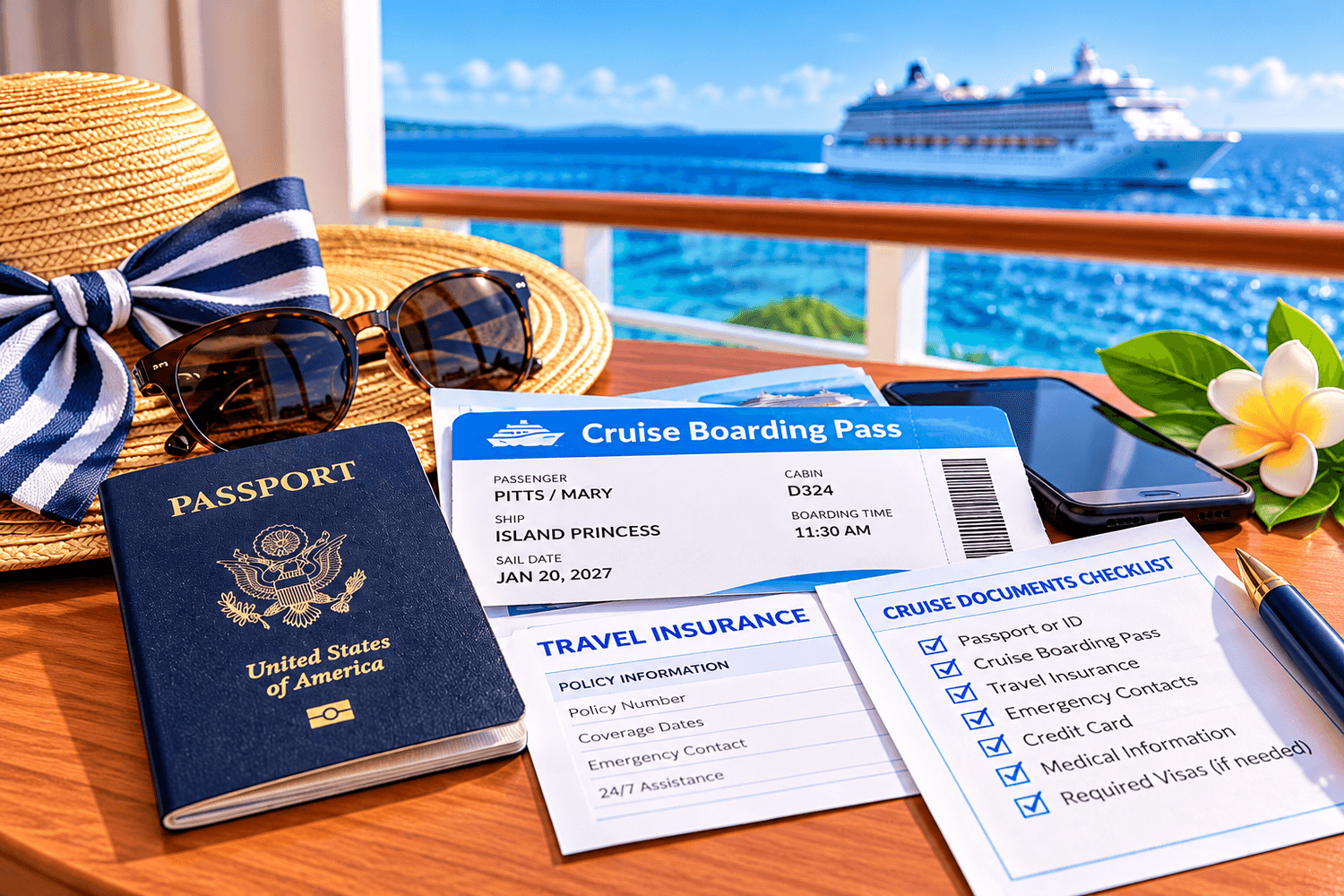
Before you start thinking about excursions, dining reservations, and what to pack, make sure your travel documents are in order.
Missing paperwork can cause delays, stress, or even prevent you from boarding your cruise.
Requirements can vary based on your citizenship, itinerary, destination, and cruise line. Taking a little time to verify your documents before sailing can help you avoid unpleasant surprises at the port.
Affiliate disclosure: This article contains affiliate links. We may earn a commission at no additional cost to you.
What Documents Do You Need for a Cruise?
For many qualifying closed-loop cruises that depart from and return to the same U.S. port, U.S. citizens may be able to travel with either:
A valid U.S. passport book
An original or certified government-issued birth certificate plus a government-issued photo ID for travelers age 16 and older
A closed-loop cruise generally begins and ends at the same U.S. port and travels within the Western Hemisphere.
For qualifying closed-loop cruises, U.S. citizens may be able to travel without a passport book. However, this exception does not apply to every itinerary, and individual destinations or cruise lines may have additional requirements.
Before traveling with a birth certificate and government-issued photo ID, confirm that your specific cruise qualifies and that your documents meet both the cruise line's boarding requirements and the entry requirements for every destination on your itinerary.
A hospital-issued birth certificate generally isn't acceptable as proof of citizenship, although limited exceptions exist for newborns.
If you're not a U.S. citizen, different requirements may apply. Permanent residents and international visitors should verify their passport, immigration documentation, and visa requirements before traveling.
Important: Always verify the specific requirements for your cruise line and every destination on your itinerary before departure.
Traveling with Children
Children may need additional documentation depending on their ages, who they're traveling with, and the countries they'll visit.
For example:
A parent traveling alone with a child
Divorced or separated parents
Legal guardians
Grandparents traveling with grandchildren
Children traveling with adults who aren't their parents
For qualifying closed-loop cruises, U.S. citizen children under 16 may generally use an acceptable birth certificate or other approved proof of citizenship without a separate government-issued photo ID.
However, some destinations require notarized parental consent letters when a child travels without one or both parents. Custody or guardianship documentation may also be necessary.
It's a good idea to carry proof of your relationship to the child, along with any required consent forms.
Don't assume the rules are the same for every cruise. Check with your cruise line and review the entry requirements for each destination well before sailing.
A Personal Tip About Passports
While many closed-loop cruises allow U.S. citizens to travel with a certified birth certificate and government-issued photo ID, we always travel with passport books.
Yes, a passport costs more upfront, but an adult passport is generally valid for 10 years, and for us, the convenience alone makes it worthwhile. Passports issued to children under 16 are valid for five years.
When returning through ports such as Tampa, U.S. Customs and Border Protection may use facial recognition technology to help process arriving cruise passengers.
In our experience, this has made getting through customs much faster and less stressful.
Depending on the port and its procedures, passengers may be directed through different processing areas, and some travelers may need additional document checks. Facial recognition isn't limited exclusively to passport holders, and processing times can vary.
After a wonderful vacation, most people are tired, carrying luggage, and ready to get home. Standing in a long customs line is usually the last thing anyone wants to do.
For us, having passports makes traveling easier and gives us one less thing to worry about.
There's another important reason we recommend them.
If an unexpected medical emergency or other problem requires you to fly home from a foreign country, you'll generally need a valid passport book.
A U.S. passport card may be accepted for certain sea and land border crossings, but it cannot be used for international air travel.
Think of a passport book as an investment in smoother travel—not just for this cruise, but for future vacations as well.
Check Passport Expiration Dates and Visa Requirements
Having a passport isn't enough if it's too close to its expiration date.
Some countries require your passport to remain valid for at least six months beyond your travel dates. Others have different requirements.
Depending on your citizenship and itinerary, you may also need a visa or electronic travel authorization, even if you're visiting a destination as part of a cruise.
Before departure, verify:
Your passport's expiration date
Any additional passport validity requirements
Visa or electronic travel authorization requirements
Whether your passport has enough blank pages, if required
Your cruise line's identification and boarding requirements
Don't wait until the last minute to discover that a document needs to be renewed or replaced.
Quick Cruise Document Checklist
✓ Cruise boarding documents, including boarding passes
✓ Valid passport book, recommended even when not required
✓ Government-issued photo ID, if applicable
✓ Passport expiration date checked
✓ Original or certified birth certificates, if applicable
✓ Required visas or electronic travel authorizations
✓ Parental consent or guardianship documents, if applicable
✓ Travel insurance policy and emergency assistance information
✓ Emergency contact information
✓ Copies of important documents stored separately from the originals
Remember that copies are useful backups, but they generally cannot replace the original documents required for boarding.
Final Tip: Check Your Documents Early
Start checking your travel documents as soon as you book your cruise, particularly if you need to apply for or renew a passport.
Passport processing times can change, and unexpected delays can happen.
Review your documents again at least a month before departure to make sure everything is ready.
A little preparation now can save you from unnecessary stress later.
After all, the last thing you want is to arrive at the cruise terminal, luggage in hand, only to discover that you can't board because of missing paperwork.
Helpful Resources
U.S. Department of State — Cruise Travel Information
Information about passport requirements, emergency travel, and preparing for international cruises.
U.S. Passport Information
Information about passport applications, renewals, processing times, and international travel requirements.
U.S. Customs and Border Protection
👉 U.S. Customs and Border Protection
Information about customs procedures, identification requirements, and returning to the United States after international travel.
Cruise Line Travel Requirements
Visit your cruise line's official website for the most current identification and travel document requirements for your specific itinerary.
Related Cruise Articles
Affiliate Disclosure: This article may contain affiliate links. If you make a purchase, book a cruise, or book a travel-related service through these links, I may earn a commission at no additional cost to you. As an Amazon Associate, I earn from qualifying purchases. Thank you for supporting Cruising Style.
Home | About | Contact | Privacy Policy | Terms of Service | Affiliate Disclosure