How to Read a Cruise Ship Deck Plan Before You Book Your Cabin
Choosing a cruise cabin can look pretty simple at first.
Interior, ocean view, balcony or suite. Pick one, choose a deck and you're done.
Except where that cabin is located can matter almost as much as the type of cabin you choose.
A beautiful balcony cabin may not seem quite so wonderful when you're listening to chairs being dragged across the pool deck above you at 6:00 in the morning. And that bargain cabin might lose some of its appeal when you discover you're at the opposite end of a very large ship from practically everything you want to do.
That's why we always recommend looking at the cruise ship deck plan before choosing a cabin.
You don't need to understand every symbol or memorize the entire ship. You just need to know what to look for.
Here's how to read a cruise ship deck plan—and how to use it to choose a cabin you'll be happier with once you're onboard.
What Is a Cruise Ship Deck Plan?
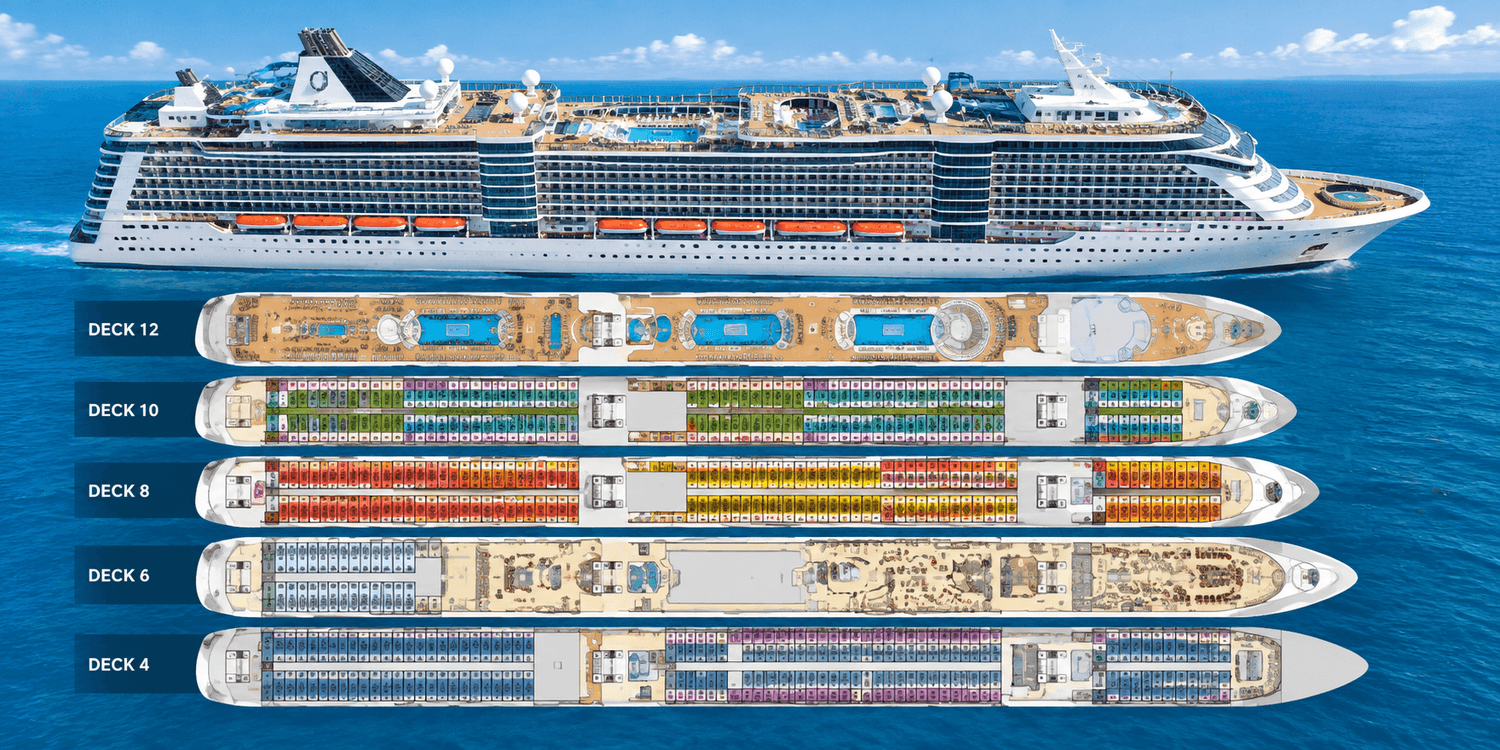
A cruise ship deck plan is essentially a map of the ship.
Instead of showing streets and buildings, it shows cabins, restaurants, theaters, pools, elevators, stairways and other public areas on each deck.
Cruise lines usually provide deck plans on their websites, and you'll often see them during the cabin-selection portion of the booking process.
Cabins are generally displayed by number and category, often using different colors to identify different types of accommodations.
The first thing to understand is that you shouldn't look at your cabin's deck by itself.
You need to look above it, below it and around it.
That's where the useful information is hiding.
Start With the Deck Your Cabin Is On
Find the cabin you're considering and look at its position on the ship.
Is it:
Forward?
Midship?
Aft?
Near elevators or stairs?
Close to a major public area?
At the very end of a long corridor?
If you're not familiar with those directional terms yet, read Cruise Ship Terms Every First-Time Cruiser Should Know before choosing your cabin.
Once you know approximately where the cabin is, start looking at what's nearby.
Look at the Deck Above Your Cabin
This is one of the most important things you can do before booking.
Don't stop after finding your cabin on Deck 8.
Pull up Deck 9.
What's directly above you?
If it's another deck filled with cabins, great. That's generally what we like to see.
But if your cabin sits underneath the pool deck, buffet, gym, nightclub or another busy public space, you may hear activity from above.
Pool decks can be particularly problematic for light sleepers because chairs and loungers may be moved around early in the morning or late at night.
A cabin that looks perfectly located on its own deck can look very different once you see what's sitting directly over your head.
Now Look at the Deck Below
Do exactly the same thing with the deck underneath you.
Again, another deck of cabins is generally reassuring.
But check carefully if your cabin is above a theater, nightclub, bar, restaurant or other entertainment venue.
Music, bass, chairs and crowds don't necessarily stop just because you've decided to go to bed.
My preference when possible is simple:
Cabins above me. Cabins below me.
It doesn't guarantee complete silence—you're still on a cruise ship with thousands of other human beings—but it removes several obvious sources of noise.
Check What's Beside Your Cabin
Now zoom back in on your own deck.
What's next door?
Most neighboring cabins won't be an issue, but look for unusual blank spaces, service areas, stairwells, crew-access areas or other features you don't recognize.
Also look for connecting cabins.
What Does a Connecting Cabin Mean?
A connecting cabin has an interior door connecting it to the cabin next door.
They're fantastic for families or groups traveling together.
If you're not traveling with the people next door, however, you may prefer a non-connecting cabin.
That connecting door is closed and locked when the cabins are occupied separately, but some passengers find that sound carries more easily through connecting doors than through a solid wall.
It's not automatically a bad cabin.
It's simply something worth knowing before you choose it.
Find the Elevators and Stairs
Being close to an elevator can be incredibly convenient.
Cruise ships are large, and walking halfway across the ship every time you return to your cabin gets old surprisingly quickly.
But there's a difference between being near an elevator bank and having your cabin immediately beside a busy gathering area.
People tend to congregate around elevators. They talk while waiting, return from bars and shows late at night and occasionally forget that hundreds of people are sleeping a few feet away.
Personally, I'd rather be close enough for convenience without being directly beside the elevator lobby.
Pay Attention to Forward, Midship and Aft
Cabin location affects more than walking distance.
It can also affect how much movement you feel.
Midship cabins, particularly on lower or middle decks, are often recommended for passengers concerned about seasickness because they're closer to the ship's center of movement.
Cabins farther forward or aft may experience more noticeable motion when seas are rough.
That doesn't mean you should never book forward or aft.
Some passengers love those locations, and certain aft cabins can have fantastic views.
But if you already know you're sensitive to motion, the deck plan can help you choose accordingly.
Related: 7 Ways to Prevent Seasickness on Your Next Cruise
Don't Assume a Higher Deck Is Always Better
Higher sounds better.
Cruise lines know it sounds better, too.
But a higher deck isn't automatically the best place for your cabin.
A cabin several decks lower may put you closer to restaurants, theaters and the gangway while also surrounding you with other cabins.
Meanwhile, a cabin near the top of the ship could place you directly underneath a busy pool deck.
Higher decks can also experience more noticeable motion than lower decks.
Choose the location that works for you, not simply the highest deck you can afford.
Look at How Far You'll Walk
This matters more on today's enormous cruise ships than many first-time cruisers realize.
Look at the places you're likely to visit frequently.
Where is the main dining room?
Where is the buffet?
Where are the theaters?
Where are the pools?
Where will you usually leave the ship in port?
You don't need to book beside everything—you couldn't even if you tried—but the deck plan can help you avoid accidentally putting yourself at the opposite end of the ship from the places you'll use most.
For travelers with mobility limitations, this becomes even more important.
Watch for Cabins Near Entertainment Venues
See a nightclub on the deck plan?
Find out what's above and below it.
The same goes for theaters, music venues, casinos and busy bars.
A cabin near entertainment isn't necessarily bad. In fact, you may love being able to walk a short distance back to your room after a show.
The problem comes when the entertainment is still going at midnight and you aren't.
Think about your own habits.
Night owl? It may not matter.
Early-to-bed light sleeper?
Give that nightclub some space.
Check the Pool and Lido Deck
The pool deck is one of the busiest areas on many cruise ships.
Cabins directly underneath it can potentially experience noise from chairs, foot traffic, music and early-morning setup.
The buffet is often located nearby as well.
Again, this doesn't mean every cabin underneath these areas will be noisy.
But if you have a choice between a cabin beneath another cabin and one directly underneath the pool deck, I'd take the cabin-under-a-cabin location.
Look for Obstructed Views
This one is particularly important when booking ocean-view and balcony cabins.
An obstructed-view cabin means something blocks at least part of your view.
The obstruction could be a lifeboat, structural equipment or another part of the ship.
Some partially obstructed cabins can actually be a good value if you're primarily interested in getting natural light or having a balcony and don't care about a completely unobstructed ocean view.
But don't discover the lifeboat outside your window after you board.
Check the cabin category and deck-plan information before booking.
Look at the Lifeboats
Even if your cabin isn't officially categorized as obstructed, it's useful to see where the lifeboats are positioned.
On some ships, lifeboats are tucked beneath or beside certain cabin decks and have little effect on the view.
On others, they're directly outside or below cabins.
This is another reason actual ship deck plans—and cabin photos when available—can be more useful than simply choosing a category based on price.
Pay Attention to Cabin Categories and Colors
Deck plans often look like someone attacked them with a box of crayons.
There's a reason.
Cruise lines use colors, letters and codes to distinguish cabin categories.
Two balcony cabins located only a few doors apart may have different category codes and different prices.
Differences can involve location, occupancy, view, cabin configuration or amenities.
Always check the legend or key on the cruise line's deck plan rather than assuming two cabins with the same basic description are identical.
Check Whether the Deck Plan Matches Your Sailing Date
This is easy to overlook.
Cruise ships are occasionally renovated or refurbished, and layouts can change.
Cruise lines may therefore provide different deck plans depending on the sailing date.
When looking at a deck plan, make sure you're viewing the version that applies to your actual cruise.
A deck plan from three years ago—or even one from before an upcoming refurbishment—may not accurately represent the ship you'll board.
Don't Choose a Cabin Based Only on Price
We're all for getting a good cruise deal.
But the cheapest cabin isn't always the best value for you.
Saving a small amount of money may not feel worthwhile if you spend the week annoyed by noise, walking an enormous distance several times a day or wishing you'd chosen a different location.
On the other hand, you don't need to spend a fortune chasing the supposedly “perfect” cabin either.
The goal is simply to know what you're buying.
Related: How to Choose the Best Cruise Cabin Location (Not Just the Cabin Type)
What About Guarantee Cabins?
A guarantee cabin changes this whole process.
When you book a guarantee (GTY) cabin, you're generally booking a minimum cabin category rather than selecting a specific cabin number yourself.
The cruise line assigns your cabin later.
That can sometimes save money, but it also means you may not get to choose whether you're near the elevators, underneath a public area or at one end of the ship.
If cabin location matters a lot to you, think carefully before giving up that control.
Related: What Is a Guarantee Cabin? Should You Let the Cruise Line Choose Your Room
Our Quick Deck-Plan Check Before Booking
Before choosing a cabin, I would check these five things:
What's above it?
What's below it?
What's beside it?
How close is it to elevators and stairs?
Where is it located—forward, midship or aft?
Then look for anything specific to your needs: obstructed views, connecting doors, long walking distances, accessibility or proximity to particular venues.
It takes only a few minutes.
Those few minutes can prevent you from spending an entire cruise wondering why you didn't look at the deck plan first.
A Deck Plan Won't Tell You Everything
Even the best deck plan has limitations.
It can't tell you whether your neighbors will slam their cabin door at 6:00 a.m.
It can't predict rough seas.
And it certainly can't identify the family whose children apparently believe the hallway is a racetrack.
You're still sharing a giant floating hotel with a few thousand other people.
But a deck plan can help you avoid many predictable problems.
And that's the point.
Choose Your Cabin With Your Eyes Open
You don't need to become an expert in naval architecture to read a cruise ship deck plan.
Find the cabin.
Look above it.
Look below it.
Look around it.
Then consider where that cabin sits in relation to the places you'll use most.
That's really all there is to it.
Once you start doing this, you'll probably never book another cruise cabin without checking the deck plan first.
Ready to compare sailings? Browse current cruises and prices with CruiseDirect.
Related Cruising Style Articles
Affiliate Disclosure: This article may contain affiliate links. If you make a purchase, book a cruise, or book a travel-related service through these links, I may earn a commission at no additional cost to you. As an Amazon Associate, I earn from qualifying purchases. Thank you for supporting Cruising Style.
Home | About | Contact | Privacy Policy | Terms of Service | Affiliate Disclosure