Do Cruise Ships Have Wheelchairs,
Walkers, or Mobility Scooters? What to Know Before You Sail
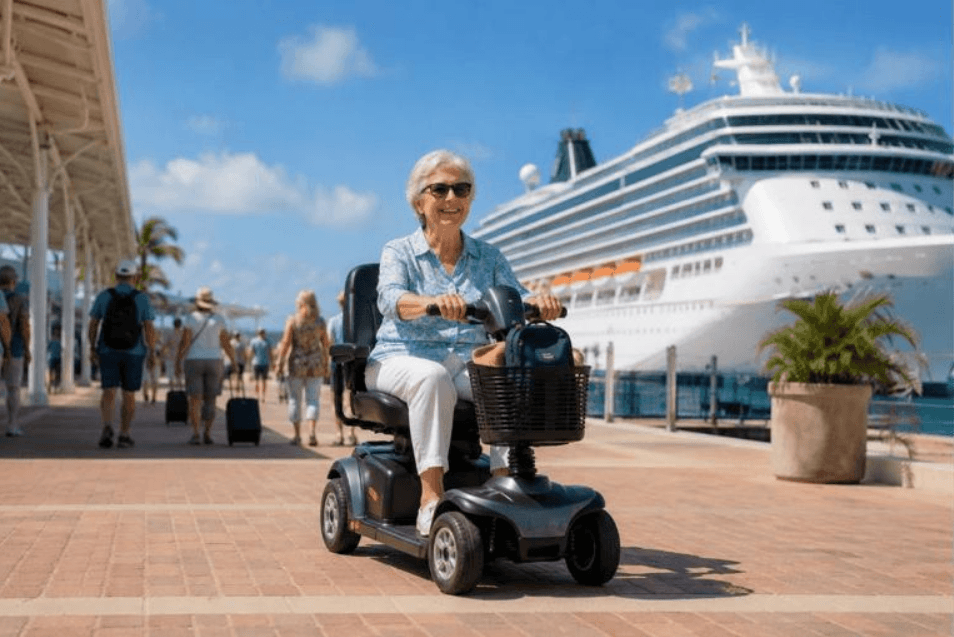
You may be perfectly capable of walking when you book your cruise and then find yourself dealing with an injury, surgery, arthritis flare, balance problem, or another mobility issue before it's time to sail.
Or maybe walking isn't usually a problem at all—until you remember just how enormous modern cruise ships can be.
That raises a very reasonable question:
If I need a wheelchair, walker, or mobility scooter during my cruise, will the cruise ship have one I can use?
The short answer is: don't count on it.
Many cruise lines provide wheelchair assistance for getting passengers onto and off the ship, but that's very different from providing a wheelchair for you to use throughout your vacation.
Royal Caribbean, for example, says complimentary wheelchair assistance is available for embarkation and disembarkation.
Norwegian says its limited supply of wheelchairs is primarily reserved for embarkation and disembarkation, although limited emergency rentals may sometimes be available.
Princess says wheelchairs and mobility scooters aren't typically available for onboard rental.
If you think you may need a wheelchair, walker, or mobility scooter during your cruise, arrange it before you leave home rather than assuming the ship will have one available for you.
Here's what you need to know.
Do Cruise Ships Have Wheelchairs?
Cruise ships generally have some wheelchairs onboard, but those wheelchairs aren't necessarily there for passengers to borrow for the week.
They're often intended for situations such as embarkation and disembarkation assistance or emergencies.
Royal Caribbean specifically says complimentary wheelchair assistance is provided for embarkation and disembarkation.
Guests who want a wheelchair or scooter during the cruise should bring their own or rent one from a company that can deliver it to their stateroom.
Norwegian Cruise Line says it has a limited number of wheelchairs onboard, primarily reserved for embarkation and disembarkation.
Emergency rentals may be available on a first-come, first-served basis, but that's certainly not something we'd recommend relying on.
Princess similarly tells passengers that wheelchairs and mobility scooters are not typically available for onboard rental and recommends arranging equipment through an approved third-party provider before the cruise.
In other words, seeing crew members pushing passengers through the terminal in wheelchairs doesn't mean those wheelchairs are available for passengers to use throughout the cruise.
What About Walkers and Rollators?
If you normally use a walker or rollator, you can generally bring your own mobility aid aboard the ship.
A folding walker can be particularly convenient because it takes up less room in your cabin and can be easier to transport.
But even if you only might need a walker, don't assume you'll be able to walk down to Guest Services on day three and borrow one.
Cruise lines don't maintain a giant closet full of walkers, wheelchairs, and scooters waiting for anyone who gets tired.
If you know you need a mobility device—or there's a good possibility you'll need one—plan for it before you sail.
Can You Bring Your Own Wheelchair on a Cruise?
Yes. Cruise lines generally allow passengers to bring their own manual or powered wheelchairs.
The important part is making sure the device is appropriate for your particular ship and stateroom.
Door width matters.
So does the size of the mobility device when it's parked.
Royal Caribbean says assistive devices should fit through a standard stateroom doorway, which is at least 23 inches wide on its ships. Its accessible staterooms have doors at least 32 inches wide.
Carnival's mobility information notes that standard staterooms and Ambulatory Accessible Cabins may have 22-inch doorways and asks guests bringing wheelchairs or scooters to provide the dimensions of their equipment.
Norwegian says guests in non-accessible cabins who use a motorized wheelchair or scooter need a device no wider than 26 inches to enter the stateroom doorway.
Those differences are exactly why it's important to check the requirements for your cruise line, ship, cabin, and equipment rather than relying on a universal measurement.
Can You Bring a Mobility Scooter on a Cruise?
Usually, yes.
Mobility scooters can make an enormous difference for someone who can walk short distances but struggles with the amount of walking required on a cruise.
And there can be a lot of walking.
Your cabin may be hundreds of feet from the elevator. Then there's the walk to dinner, the theater, the buffet, the pool deck, and eventually all the way down the pier once you reach port.
For someone with limited endurance, those distances add up quickly.
But scooters require more planning than a cane or folding walker.
Before bringing one, check your cruise line's rules regarding its dimensions, battery type, charging, cabin storage, and any advance-notification requirements.
Your Scooter or Wheelchair Has to Go Somewhere at Night
This is one of those details that's easy to overlook when you're booking your cruise.
Your mobility equipment generally needs to fit inside your stateroom.
You can't simply park a scooter in the hallway outside your cabin.
Royal Caribbean specifically requires assistive devices, including scooters, to be stored and recharged inside the stateroom so corridors, elevator lobbies, and fire doors remain clear for emergency evacuation.
That makes sense when you think about how narrow cruise ship hallways can already become when housekeeping carts are in use.
So before renting or bringing a scooter, make sure both the device and the cabin you've booked will work together.
Should You Book an Accessible Cruise Cabin?
Not everyone who uses a cane, walker, wheelchair, or scooter necessarily needs a fully accessible cabin.
But if you require features such as wider doorways, additional maneuvering space, a roll-in shower, grab bars, or other accessibility features, an accessible stateroom may be important.
Norwegian, for example, says its wheelchair-accessible staterooms include wider door frames, roll-in showers, shower benches, higher toilets, and handrails.
Accessible cabins are limited, so if you know you need one, this isn't something we'd leave until the last minute.
Can You Rent a Wheelchair or Mobility Scooter for a Cruise?
Yes, and for many passengers this may be the easiest solution.
Third-party mobility companies can provide equipment for cruise passengers, and depending on the cruise line and embarkation port, the equipment may be delivered directly to the ship.
Royal Caribbean currently identifies Scootaround and Special Needs at Sea as companies from which passengers can rent wheelchairs or scooters for delivery to their stateroom.
Princess also allows arrangements with approved third-party providers.
Renting can be particularly helpful for someone who doesn't normally use a scooter at home but knows that walking considerable distances around the ship and ports could become difficult.
Make those arrangements well before your sailing date rather than waiting until you arrive at the cruise terminal.
What If You Only Need Help Getting Onto the Ship?
That's a different situation.
You might be able to walk around the ship once you're onboard but have difficulty standing in a long terminal line or walking the distance from check-in to your cabin.
Cruise lines can provide boarding assistance for passengers with mobility limitations.
Royal Caribbean, for example, offers wheelchair assistance during embarkation and recommends requesting pier assistance in advance.
If that's all you need, you may not need to rent a wheelchair for the entire cruise.
Just make sure you've checked your cruise line's procedure before arriving at the terminal.
What If You Suddenly Need a Wheelchair During the Cruise?
This is where things become less predictable.
Maybe you twist an ankle on an excursion. Maybe an existing condition unexpectedly worsens. Maybe you simply discover that you're having much more difficulty walking than anticipated.
If you've had an injury or a sudden change in your ability to walk, contact Guest Services or the ship's medical center.
There may be a wheelchair available for an emergency or temporary assistance, but availability isn't guaranteed. Norwegian, for example, specifically describes its emergency wheelchair rentals as limited and first come, first served.
That's another reason we wouldn't plan a cruise around the idea that you'll simply borrow one onboard if you need it.
Don't Forget About Travel Insurance
A mobility problem can also become more than an inconvenience if it's caused by an unexpected illness or injury before or during your trip.
Depending on the policy and circumstances, travel insurance may provide benefits for covered situations involving trip cancellation or interruption, emergency medical care, medical evacuation, and other unexpected travel problems.
Coverage, exclusions, pre-existing-condition provisions, and eligibility requirements vary considerably, so read the policy details carefully before purchasing.
Want to compare cruise travel insurance options? Use Squaremouth to compare plans and coverage from multiple travel insurance providers before you sail.
👉Compare Travel Insurance with Squaremouth
What About Getting Off the Ship in Port?
This is where accessibility can become considerably more complicated.
A cruise ship may be very accessible while the port you're visiting is not.
Gangways can become steep depending on the pier and tide. Port transportation may not accommodate a scooter or wheelchair. Streets and sidewalks can be uneven. And some excursions require passengers to climb steps into buses, vans, or boats.
Then there are tender ports, sometimes called water-shuttle ports.
Instead of walking down a gangway directly onto a pier, passengers transfer from the cruise ship to a smaller boat that takes them ashore.
That transfer isn't always possible with a wheelchair or scooter.
Whether a mobility device can be taken aboard a tender can depend on the cruise line, vessel, equipment, weather, tides, sea conditions, and port facilities.
Never assume that because you can get around the ship, you'll automatically be able to get ashore at every port.
What About Accessible Shore Excursions?
Some cruise lines offer shore excursions designed for passengers with mobility limitations, but availability varies considerably by destination.
Read excursion descriptions carefully.
Look for information about steps, walking distances, terrain, vehicle access, wheelchair lifts, and whether a mobility device must fold.
And don't be afraid to contact the cruise line before booking an excursion if the description doesn't clearly answer your questions.
Tell the Cruise Line About Your Mobility Needs Before You Sail
Even if you're bringing all your own equipment, it's a good idea to contact the cruise line's accessibility department before sailing when you have significant mobility needs.
Some cruise lines specifically request advance notice for certain accommodations.
Advance communication also gives you time to resolve problems involving cabin accessibility, equipment dimensions, transportation, batteries, or embarkation assistance before you're standing at the cruise terminal with your luggage.
That's a much better time to discover a problem than embarkation morning.
What Should You Check Before Your Cruise?
If you or someone traveling with you uses a wheelchair, walker, rollator, or mobility scooter, confirm these things before leaving home:
Whether you'll bring your own mobility device or rent one
Whether the device fits through your cabin doorway
Whether you need an accessible stateroom
Where and how powered equipment can be charged
Whether your cruise line requires advance notice
Whether you need wheelchair assistance during embarkation or disembarkation
Whether your ports are docked or tender ports
Whether planned shore excursions can accommodate your particular mobility device
A little planning before the cruise can prevent a very frustrating surprise once you're onboard.
Don't Underestimate the Amount of Walking on a Cruise
One of the biggest misconceptions about cruising is that because you're vacationing on a ship, you won't do much walking.
You absolutely can.
Modern cruise ships are enormous, and simply going about your day can mean traveling considerable distances between your cabin, restaurants, theaters, lounges, shops, and outdoor decks.
Add a long pier and several hours exploring a port, and someone who manages normal daily walking perfectly well at home may suddenly discover they've reached their limit.
If you're uncertain about your stamina, talk with your healthcare provider before traveling and think realistically about how much walking you'll be doing.
Using a mobility aid when you need one isn't going to ruin your vacation.
Being stranded halfway down a very long cruise ship corridor wishing you'd rented one just might.
The Bottom Line
Cruise ships are increasingly designed to accommodate passengers with mobility limitations, but that doesn't mean you can count on borrowing a wheelchair, walker, or scooter whenever you need one.
Cruise-line wheelchairs may be reserved primarily for embarkation, disembarkation, and emergencies.
If you'll need a mobility device regularly during your vacation, the safest plan is to bring your own or arrange a rental before your cruise.
Check the specific accessibility policies for your cruise line and ship, make sure your equipment will fit inside your cabin, and investigate accessibility at your ports and on your shore excursions.
Those few steps can make the difference between spending your cruise worrying about how far you can walk and actually enjoying where the ship is taking you.
Ready to Compare Cruises?
Once you've found a ship and itinerary that work for your mobility needs, you can compare current sailings, dates, and cruise prices with CruiseDirect.
👉Compare Cruises with CruiseDirect
Related Articles
Affiliate Disclosure: This article may contain affiliate links. If you make a purchase, book a cruise, or book a travel-related service through these links, I may earn a commission at no additional cost to you. As an Amazon Associate, I earn from qualifying purchases. Thank you for supporting Cruising Style.
Home | About | Contact | Privacy Policy | Terms of Service | Affiliate Disclosure